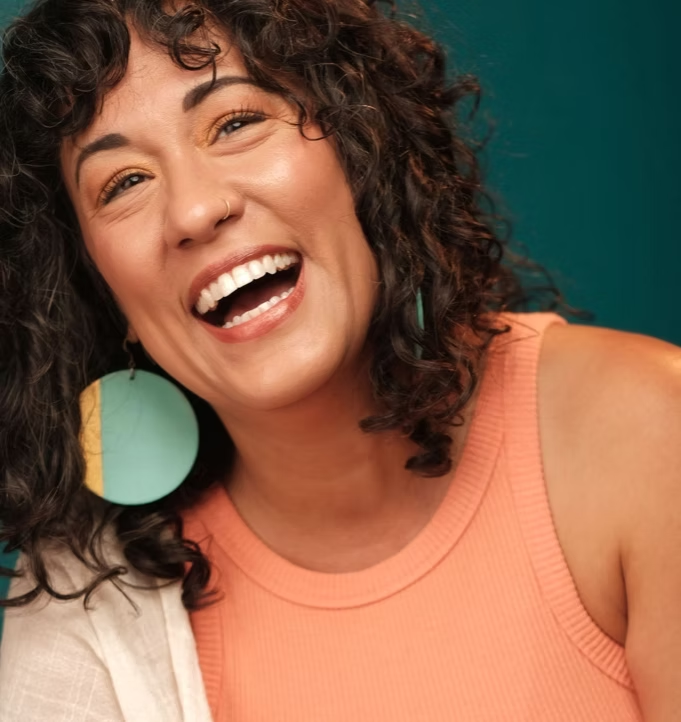
Chicago’s second-ever Poet Laureate is none other than Mayda del Valle.
Born and raised on Chicago’s southside, Mayda has been a Poet in Residence with the Chicago Poetry Center for years, and critically, built our Spanish language curriculum, which she teaches in schools across Chicago. A long-time and much-lauded performance poet, with deep ties to community work and a multi-hyphenate creative background (dance, singing, and writing!), Mayda has been in the field bringing magic to the page, the stage and the classroom, from Chicago to LA and back.
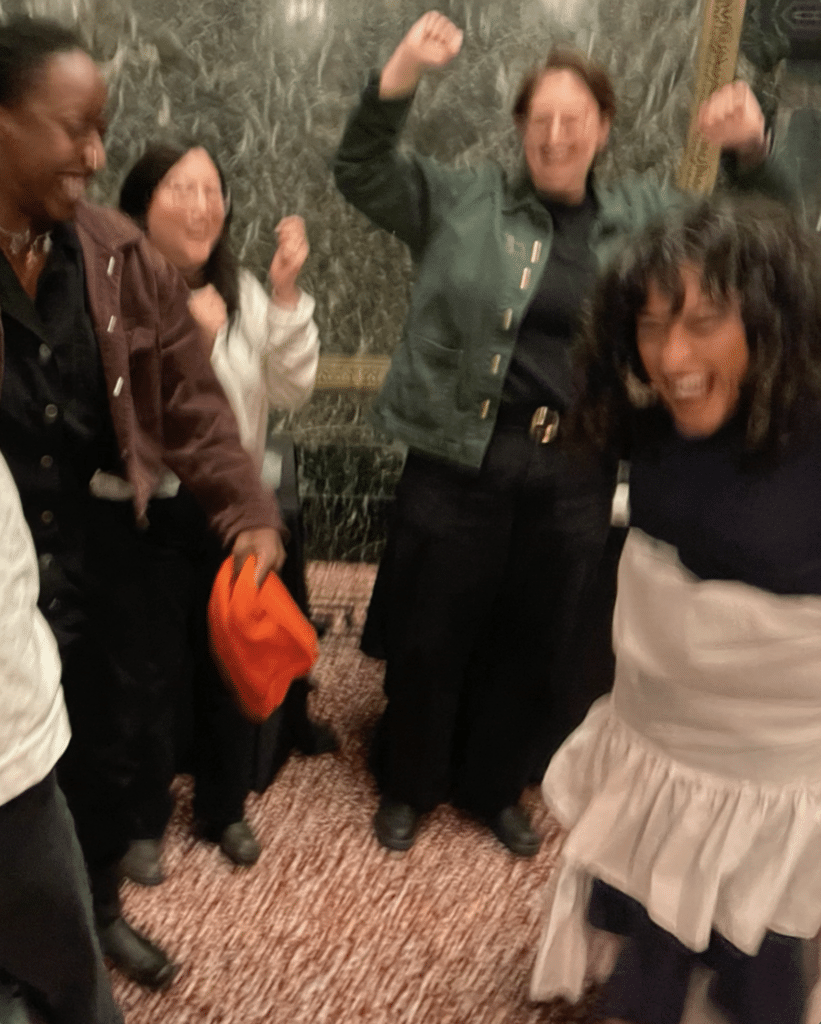
To say that all of us at Chicago Poetry Center are excited for Mayda’s term would be an understatement–we are a celebratory bunch and we have whooped, danced, and cheered mightily along the way as this honor as been bestowed on Mayda. Here’s a joyously blurry photo of some of our staff and Poets in Residence celebrating together at her inaugural reading in January of this year.
Mayda and I sat down for an interview to discuss what she’s excited to create with Chicago during her term as poet laureate. The interview ranged from how to be a creative leader in this political moment to how to listen to young people, and from creative and political practices to spiritual practices, and how they can collectively create a values-driven super glue to carry us forward. We hope you enjoy!
B: I am curious what you are currently most excited about within the position, with just a few weeks under your belt, how are you thinking about making this your own?
Mayda: One of the things I’m excited about is just going to different parts of the city and connecting with different writing communities, following in avery‘s footsteps of offering these workshops, but making them my own. Creating opportunities for people to tell their stories, write their stories, and do it in community, and just get people to understand that the stories are already inside of them, and that they can tell them. I’m just going to give you some tools to help you along the way, and maybe make it a little bit easier and a little sharper.
Having been gone for so long, there’s still parts of the city that I never had the opportunity to get to know. And having been here as a young person, really focused on being on the south side, there’s parts on the north and west side that I’m still learning about, I’m excited about going into different neighborhoods. I feel like I’m falling in love with the city all over again.
B: I love that about Chicago. You can forever have those experiences with this city. I appreciate what you were saying about storytelling and encouraging folks into their own story.
M: I’m really looking forward to hearing how people love the city or identify with the city in different ways. You know, there’s a different experience for people in Humboldt Park than there is for people in Marquette Park, where I grew up. And so I think one of the things I’m really excited about is building out an opportunity for the city to write together and to talk about why they love the city.
B: You’ve been a teaching poet in Chicago for a long time, and in CPC’s programs you teach in Spanish and in English, and in classrooms across the city. I’m curious how that impacts your experience of the role and responsibility of Poet Laureateship.
M: The word that comes to mind is access; making sure that poetry is accessible. Because there’s been such an influx of people arriving to Chicago in the last couple years, just being in the classroom, getting from one semester to the next, having 14 new kids across a couple of classrooms, and seeing the relief on their face when they’re able to communicate, and when I tell them it’s okay just write in Spanish, and then you hear these stories emerge, right?
Their grasp of language and of concepts is sometimes so far ahead of what we give students and children credit for. I grew up in a bilingual household. Spanish was my first language until I was told that I shouldn’t speak it in school and so then that language learning kind of stagnated for me. It’s important for me to create a space where every student feels like they can express themselves in the way that they really need to or want to, or if they’re writing in English, but they hear something in their house that’s in Spanish and and they feel confident enough or safe enough to be able to put that into a poem to be proud of that and not not feel like they have to hide who they are. Not have to feel like they have to hide where they come from.
Especially given the environment that we’re living in now where people are literally hiding for their safety. To walk into a classroom and tell a student you don’t have to hide who you are, you can share it. It’s something that you should be proud of, and you should tell the story. There’s people who want to listen to this. So access and visibility is important.
I started teaching at Perez last week, and Ms. Murray was like, I showed them some of your news clips and they’re very excited. And it’s great because I always wanted to see myself in places and be able to be in a visible position where students, Latino students and non Latino students, students of color, or students who are creative, because there’s so many.
B: I have always found teaching such a powerful way to stay connected, especially intergenerationally. As adults, we don’t always have access to the thoughts of a whole bunch of 12-year-olds or whatever age we’re working with, and so being in the classroom gives you so much of what’s going on right now.
M: We don’t give them enough credit, right? And we don’t ask our youth enough about how we can make the world a better place, and they have so many ideas and so many answers. And they’re one of the most disenfranchised populations in our country because we don’t ask them what they want.
B: I’m curious if there’s something you could impart to all your students, and whether it’s the same or separate, also if there’s something you could impart to all their parents.
M: Okay, so for my students, I love them so much: What you have to say is valuable. Period. What you think is valuable, your experiences are valuable, your story is valuable. Your life is valuable. It’s necessary. It’s needed in the world. There’s something that you bring into this world that only you can express in this way. Nobody else is going to be able to do it in the way that you do it. And that’s what you’re here to share.
And for parents, I would say take the time to just sit and listen. Ask them questions, be curious about their minds. So much, much love to parents, it is probably one of the hardest jobs ever. I get such a kick out of just talking to [my students] and listening to them process their experiences and their thoughts and their big feelings. One of the things that my students always tell me, I just want my parents to listen to me and not judge me. I just want them to hear me. Any grade, my mom just doesn’t listen to me. What would you want at that age? And more times than not, it’s just they want to be heard and seen.
“There’s something that you bring into this world that only you can express in this way. Nobody else is going to be able to do it in the way that you do it. And that’s what you’re here to share.”
B: That’s probably just great advice for all of us, right? Start with curiosity, whoever you’re speaking to, whoever your child or otherwise.
M: Anybody? Right? I used to facilitate and we’d say, assume the best first. We come in with so much of our own stuff. We don’t even hear people from the place that they’re coming from. We hear them from the place that we are.
B: On that note, this is such a time of collective strain in our city, in our country, globally. There’s so much strain on our community, on our city and beyond, and I’m curious how that reality is coming into your thinking or experience of this role as Poet Laureate of Chicago.
M: When I got the update that I was getting vetted, there was definitely a little nervousness because of the environment that we’re in, the time that we’re in. People are being censored. People are being attacked online, or in real life. But there’s also a sense of, Well, this is a really great time for me to say all the things that need to be said, to write the poems that need to be written. It’s like Toni Morrison said, the time is now. Now is when artists go to work. These are the times that we write, and we don’t allow ourselves to drown in the hopelessness or the darkness, this is when we do what we do. And so it felt like a responsibility, a sense of weight to it, especially given everything that’s been happening in the city with ICE and in the administration. Walking into a classroom and just hearing a kid say, Yeah, my dad got deported. You know, that’s a lot. To step into the role of the kind of artists that we need at this time.
avery gave me some advice. He said, when he became poet laureate, he spoke to Angela Jackson, and he asked, did you feel pressured to write better poems. And she goes, Oh, but you must. And I was like, Oh, my God I gotta write the poems that these times need. Yeah, I got to write the poems that if I was a fifth grader living at this time what are the poems that I would have needed to read?
B: When I’m thinking about Chicago and poetry and what’s really special about our city’s poetry community, I believe that it is this inextricable tie between poetry as a creative art, and organizing and activism in this city, they are inseparable here. I really love that about us.
But I think there’s a third thing that naturally ties in with those two that you and avery both exemplify as our first and next poet laureate, which is that in addition to being tied to the sociopolitical moment and our creative community, you’re also people who are deeply connected to spirit, and that connects you to these other things and it is maybe a bonding material. For many of us who see those first two categories as inextricably connected [poetry and organizing], maybe they’re bonded by the third?
M: One hundred percent. I mean it happens with the bomba community too. When I was living in LA I was working in a nonprofit out there for a while, and then I started Afro Cuban dance, and that’s where I started finding people in Ifá and in Santeria. And then I started going to the spiritual ceremonies and to the spiritual communities. And everybody in those spiritual communities was either an artist or an activist or an organizer. There was always so much overlap in those communities. I think it’s because of a couple different things. I think that when you are an artist, I think creating art is a spiritual experience, like you have to allow yourself to be a vessel for something. Where do those ideas come from? People? People might not think of it this way, right?
But that is a spiritual experience to receive a vision, to hear something, to feel something, to sense something, to sit down and to give form to an idea that you see, hear, or feel in your mind, in your heart or in your spirit, right? That’s a spiritual act, that’s a godly act, right? In any sacred text the closest you can get to God is the act of creation, right? Whether it’s creating a piece of art, a piece of music, right? There’s spiritual traditions where art is not made for art’s sake. Art is made as a service to community, whether it’s women coming together to take clay and make water vessels for people to carry water. They do it together. And they mold the clay together, and they sing songs together. And that’s a spiritual act too. And you know where people come together and they make their regalia and community.
I’m thinking of New Orleans, or Native American tribes here too, where they create these things in community, for each other, for use. It’s not something outside of yourself. It’s not something outside of the community. It is in service of your most human self, and it’s in service of the betterment of the society. And then, because in the West, we’re separated, we’re taught art is not a part of you. Art is just a commodity. And we’re forced to organize because we live in such disconnection from each other, it only makes sense that if you’re an artist, or if you’re an organizer, that you have to find some sort of spiritual connection or spiritual community to fortify yourself in, because we live in a world that is completely, disconnected where art is in service. We’re not taught that, we’re not taught that art is in service to something bigger. Art here is in service for yourself. Art here is in service of fame. Art here is in service of systems and corporations and record companies that turn it into something that you can consume. And so if you are truly connected to that creative spirit, then I feel like, here you have to find a community to fortify yourself in.
So it makes perfect sense to me that whenever I go into deep spiritual communities, I’m always running into people who are artists. I’m running into the people who are organizing. I’m running into the people who are doing the work in the schools. I’m running into the people who are creating some of the most interesting, innovative, radical things whether it’s painting or dancing, music, or writing.
B: Yes, another way to say it would be that in a culture that is without a central core of spirit, value, community, connection, these are the people who find their way back to those essential needs. And it makes sense that we find pieces of it here, pieces of it here, pieces of it here. And then we all find each other, circulating through these spaces as well.
M: Yeah, and it’s often also people who participate in non-traditional religions or spiritual practices too. But so many of the people that I meet are either deeply into indigenous, afro, or African centered spirituality in traditions. Or, you know, they’re Christian, but they’re deep meditators. Or into Buddhism, into non traditional Western practices…
B: Religions that are existing, or spiritual practices that are existing outside of a power structure with a lot of hegemony to it.
M: Yes, yes. Or even Father Pfleger, right? He’s a deeply rooted Catholic priest. But he’s also more on the liberation theology side, than anything else. And he’s notorious for having these deep roots in organizing and community organizing as well.
B: I appreciate you going into that query with me. I think this combination of spiritual, political, and creative engagement is of the things that makes you a poet that we can all connect with so deeply, and I have to say the poems that you shared at your first reading as our Poet Laureate at at the Chicago Cultural Center felt like an imbued concoction of all these things we’re talking about. They were calling in a lineage of family voice, which, of course, has a spiritual connection to it and a political and social communication behind it.
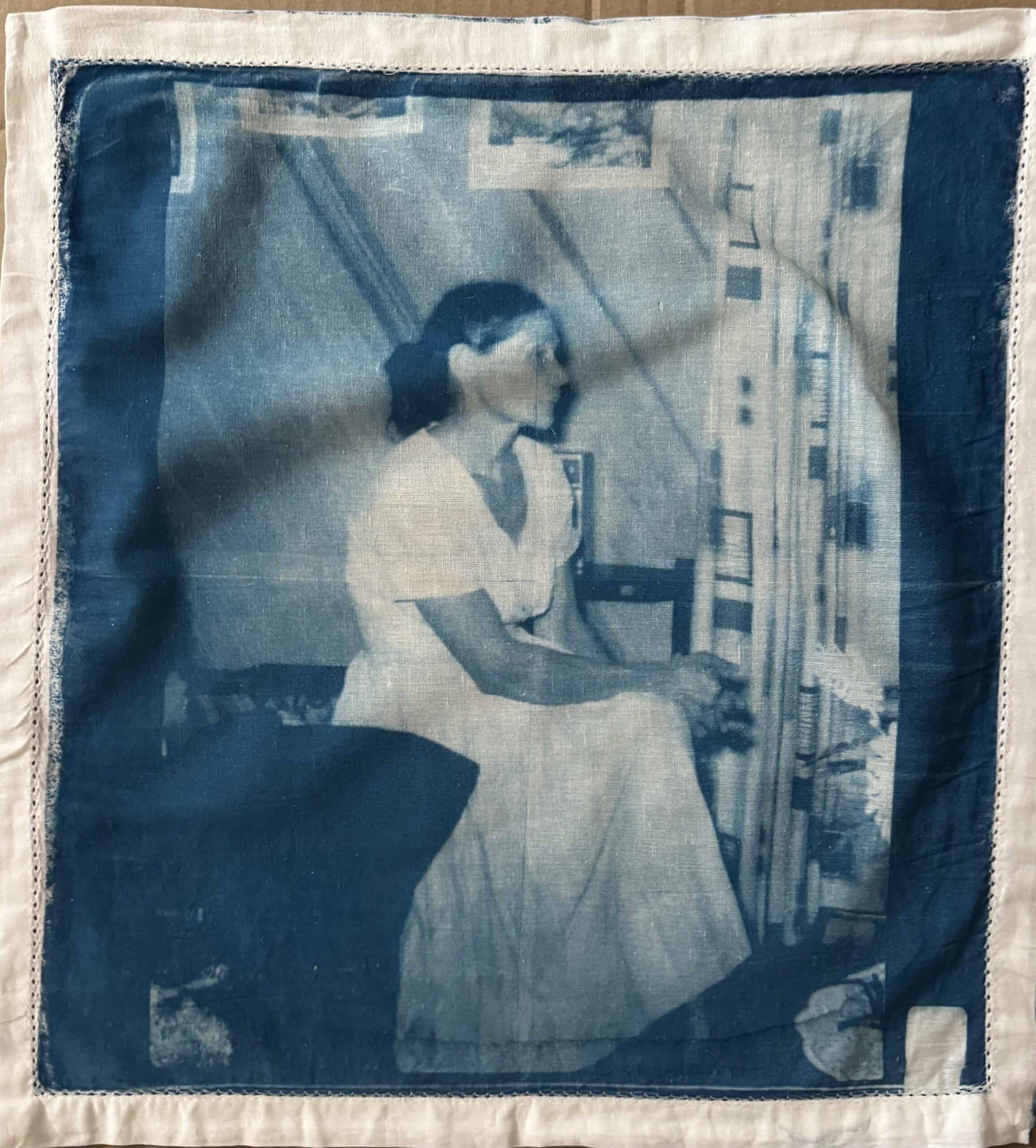
M: Yeah, those are my mom’s parents. [Mayda points to a photo in her office.] This is my photo in Humboldt Park, like it’s a Vejigante. And then these are my dad’s parents. And then these are the cyanotypes that I was working on. I was taking archival photos and turning them into negatives and printing on fabric. So I was like, I gotta bring them. They gotta be here with me.
B: The way you were speaking about our waterways, how you connected Lake Michigan and the Chicago River to the Mississippi and to the ocean and to the ways we are all connected by this, that’s a very strong moment of spirit in that poem that is also political and social. I get this sense in the things that you’re writing right now, that you’re gathering us all, and the us is not just humans. I think it includes the more than human community of beings, like our amazing waterways that are so much a part of us.
M: People always talk about Chicago, like, Oh, the Chicago Fire, we’re such a city of fire. And I’m like, No, we’re not, yeah, no, the fires were man made. The fires were man caused. We are a city of water. Yes, we are. We sit near one of the tributaries to one of the largest rivers. We were a waterway before there was a city. We were a point of gathering for different tribes in this area. They knew how important these waterways were. They led the colonial settlers through the waterways of this city. We are the shores of Lake Michigan and the Great Lakes. Prairie land is essentially old beach land from these old waters receding, right? So this was all underwater. When that all started to recede, it’s what you see when you go up to Zion and Illinois State Park. All the swampy lands. We’re left with the leftover remnants of an ocean. There’s seashells in Lake Michigan. There’s rocks at the bottom of Lake Michigan that are carved with Mastodon and ancient, ancient animals, right? We’re a water city.
And I’m initiated into Ifá, but I’m a child of Olokun. Olokun is the spirit of the ocean. It’s the owner of the sea. It’s the owner of all the waters, really, right? It’s a local owner of the sea, but, but you can call Olokun at any body of water. Olokun represents also the first ocean on this planet. Olokun is the primordial waters.
And so for me, it’s thinking about Chicago and thinking about the peoples and all the people who ended up here. That’s really wild, right? Black Americans in the Delta came up this way. There were Puerto Ricans when they first started coming to the United States after the Jones Act. In 1917 they came on boats to New Orleans, and then they made their way up to Chicago and started settling here in the late 1800s or, you know, 1920s there’s a whole population of Puerto Ricans living on 47th and Indiana. Some have been on the south side since the beginning of the last century. Yeah, water is the one universal human thing that connects us.
B: Yep. And we’re all water bodies ourselves.
M: We’re all water bodies anyway.
B: Well, thank you for letting me take this in all kinds of directions.
M: You’re so welcome. Thank you for the last question that was awesome. That’s such a great question.
B: I want to emphasize again and again how much everyone at the Chicago Poetry Center is celebrating you and this laureateship. We’re so excited, so proud. That first reading that you gave as laureate truly blew me away. It was so emotional, you probably couldn’t tell because you were on stage, but we were all crying. You had probably twenty CPCers present, and we were all welling up. After, everyone just kept speaking to each other about what a balm this was in such a dark time. This is the kind of light that we need that’s not pretending the dark is not there and not ignoring it. It’s speaking to the situation proudly and boldly, but also with celebration and spirit and all the power behind those things. I’m so excited for all the poems and the work that is ahead.
M: I make everybody cry. I’ve been doing all these events, I’ve been reading that Chicago poem. I kind of do that I guess.
B: They’re good. They’re cleansing tears.
M: Yeah, that’s what we need.
Mayda del Valle is a Chicago-born writer and multidisciplinary artist whose work lives at the intersection of poetry, performance, memory, and community. Rooted in the Puerto Rican diaspora and shaped by hip-hop, movement, and visual art, her practice transforms personal history into shared ritual.
Whether on stage, in classrooms, or in public space, she creates work that invites people to see themselves reflected, work that asks us to remember where we come from and imagine what we can build together. Learn more about Mayda’s work on her website.