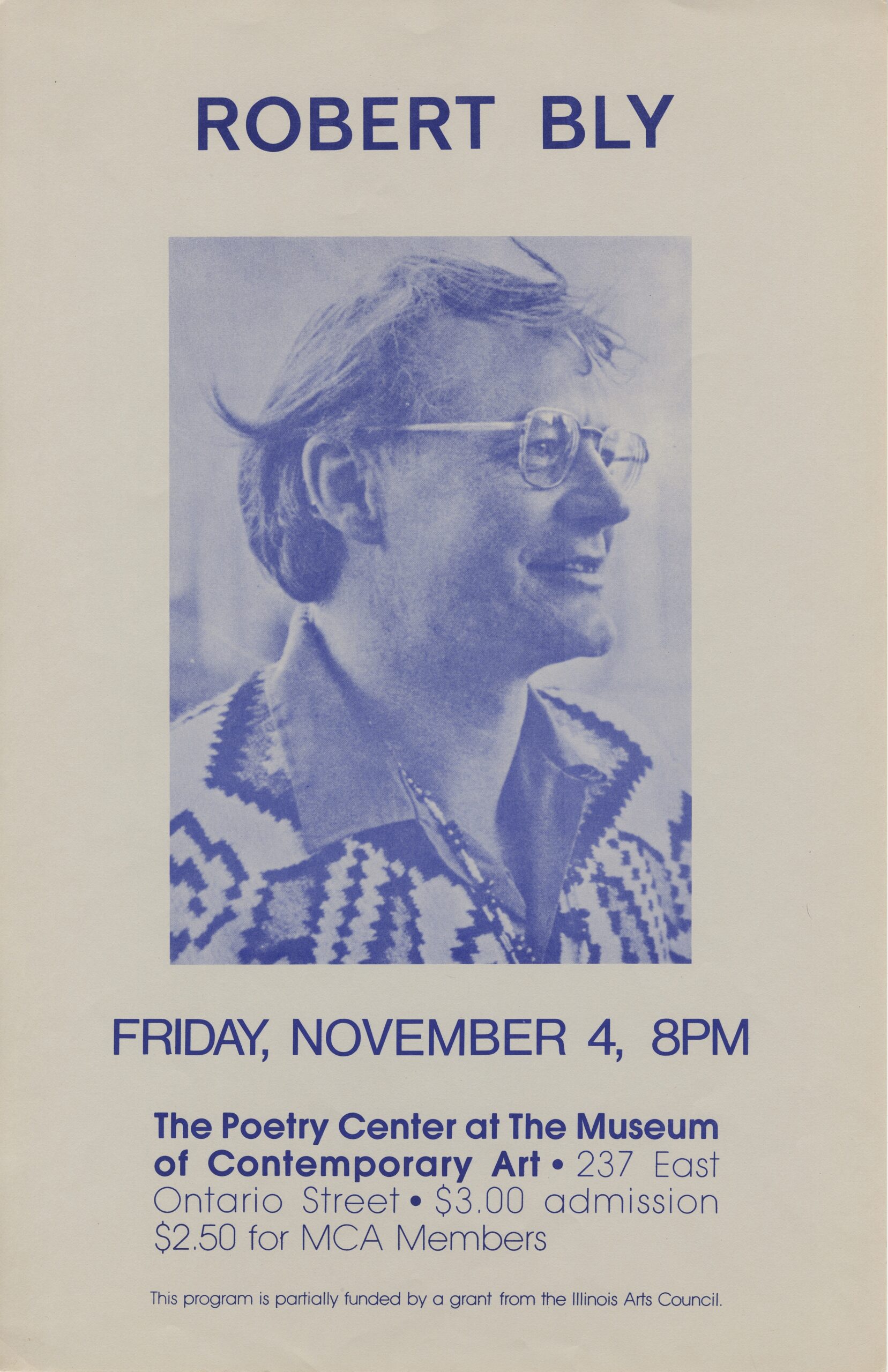
Robert Bly
American writer Robert Bly is regarded as “one of the legends of contemporary poetry,” according to David Biespel, “the prototypical non-modernist the one who set in motion a poetics of intensity for generations to come.” The author of dozens of books of poetry and translation, Bly’s work is based in the natural world, the visionary, and the realm of the irrational. As a poet, editor, and translator, he profoundly affected American verse, introducing many unknown European and South American poets to new readers. In addition to his poetic endeavors, he gained attention for his anti-war protest efforts, his theories on the roots of social problems, and his efforts to help men reclaim their healthy masculinity and channel it in a positive direction. Bly’s poetry was often categorized as part of the Deep Image school of writing, in which the poet employs a system of private imagery; however, Bly’s wish was not to create a personal mythology, but rather to describe modern American life through powerful metaphors and intense imagery. Two of his major inspirations in this regard were Spanish-language writers César Vallejo and Federico Garcia Lorca. Hugh Kenner, writing in the New York Times Book Review, remarked that “Bly is attempting to write down what it’s like to be alive, a state in which, he implies, not all readers find themselves all the time.”
Poetry by Robert Bly
Inside the veins there are navies setting forth,
Tiny explosions at the waterlines,
And seagulls weaving in the wind of the salty blood.
In the deep fall, the body awakes,
And we find lions on the sea-shore–
Nothing to fear.
The wind rises, the water is born,
Spreading white tomb clothes on a rocky shore,
Drawing us up
From the bed of the land.