Featured Readers
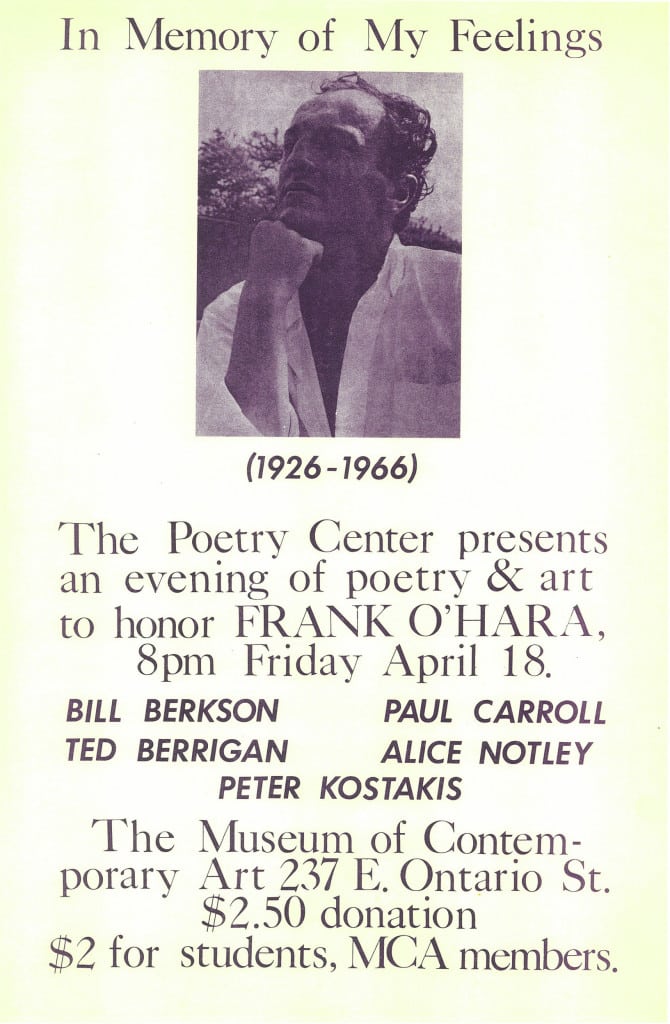
Ted Berrigan was born Edmund Joseph Michael Berrigan, Jr. in Providence, Rhode Island, the oldest of three children of Margaret Dugan and Edmund Berrigan, the chief engineer at Ward’s Baking Company. On both sides the family was Irish Catholic. Berrigan attended local schools and entered Providence College, a local Catholic school, but left after a year and enlisted in the army. Berrigan was sent to Korea in 1954 but never saw action in the Korean War. Then, 16 months later, he returned to the United States and was based in Tulsa, Oklahoma. He enrolled in the University of Tulsa under the GI Bill, earning his BA in 1959 and his MA in 1962, after writing his master’s thesis on Bernard Shaw. Berrigan returned the diploma for his MA to the university with a note saying that he was “the master of no art;” he was, he would tell friends, a poet because he wrote poetry, not because he had mastered poetics. To say that one could “master” an art was to imply that it was a matter of learning lessons and following rules.
Poet and editor Paul Carroll was a vital force on the Chicago poetry scene. He was briefly an editor of the Chicago Review (1957-1958), but when he and coeditors were pressured by the university chancellor to remove controversial pieces from an upcoming issue from William Burroughs’s Naked Lunch, he pulled the entire issue and resigned in protest. Carroll founded the little magazine Big Table, where he published the suppressed material; the United States Post Office then seized 400 copies of the first issue and refused to deliver them, declaring the magazine “obscene,” but their decision was appealed and reversed. Carroll would continue to publish work by innovative writers such as Burroughs, Jack Kerouac, Allen Ginsberg, Robert Creeley. He also founded the Poetry Center of Chicago, and in 1985 he won the Chicago Poet’s Award.